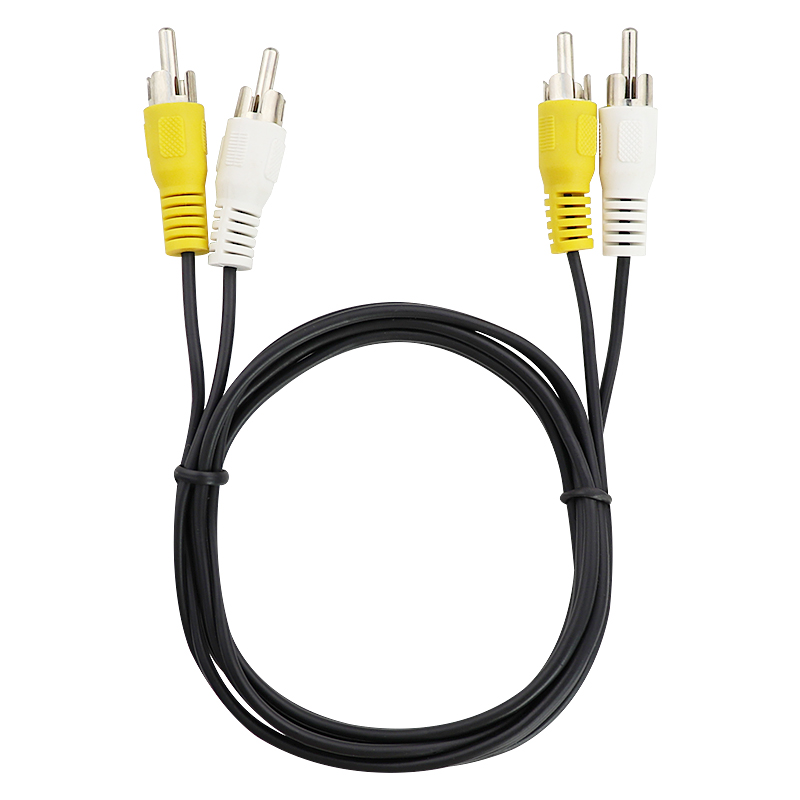
There are many types and specifications of audio cables. According to the number of core wires, there are single-core, double-core and multi-core wires; according to the thickness of the wire, there are 0.1, 0.15, 0.3 square millimeters and other specifications; according to the density of the shielding layer , there are 96 nets, 112 nets, 128 nets, etc. According to the weaving method of the shielding layer, there are net type and wrapping type, etc. The following types are common audio cables, you can use them as a reference.
Canon head (XLR)
XLR Pro Audio Cable, XLR Male/XLR Female
It is mostly used for the connection between microphones, sound cards, mixers and processors in sound reinforcement systems. The Canon cable belongs to balanced transmission and is anti-interference.
Lotus head (RCA)
RG59A coaxial cable, RCA male / BNC male
Mostly used for connection of jukebox, DVD, TV and radio equipment. The lotus line belongs to mono unbalanced transmission, and the double lotus line can form a stereo.
3.5mm (small three-core) connector
It is generally used to connect to the audio output port of a mobile phone or PC. Some headphone cables are four-core connectors, and one more core is used to transmit MIC audio.
6.35 Connector
Right Angle TRS 1/4" (6.4mm) Adapter, Male/Female
6.35 connector can be divided into: big three-core TRS and big two-core TS. Generally used to connect electric guitars, mixers and other equipment. The difference between the two is that the three cores can be used for balanced connection or dual-channel connection.
3.5 turn double lotus
It is mostly used for mixing consoles for mobile phones and computers to connect to sound reinforcement systems, and for stereo transmission.
Canon (female) head to 6.35 (big two core) is mainly used for mono transmission.
Well, after understanding the various audio cables and usage scenarios, do you know what kind of audio cable to choose? For novices, it is also common to confuse the types of audio cables. After all, their specifications and functions are diverse and cumbersome. For beginners, it is not practical to find out all at once. But there are also obvious differences between low-quality wires and high-quality wires, such as appearance materials, welding quality, flexibility, and durability comparisons, which are still very easy to see.