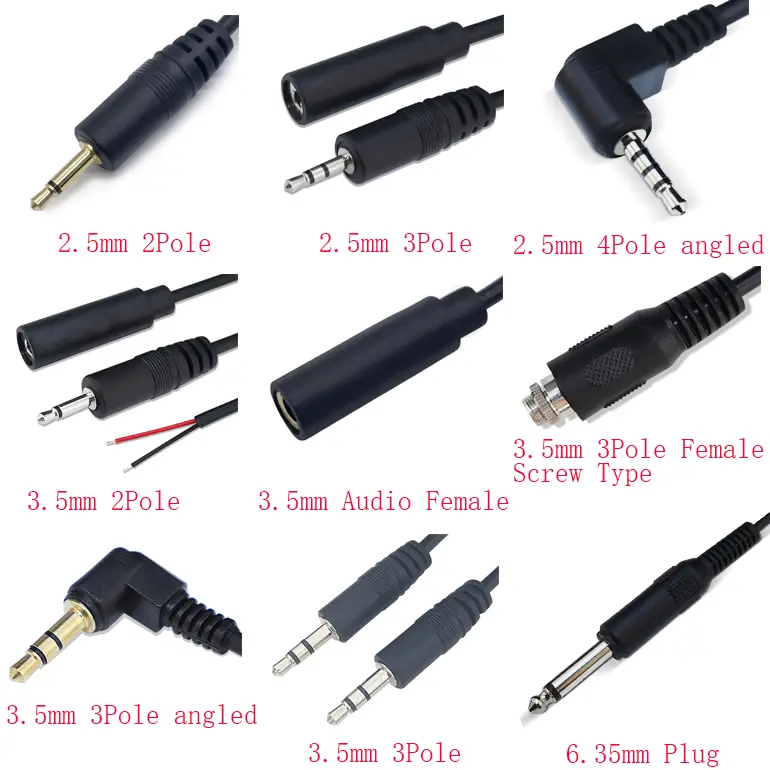
(1) Microphone cable
The microphone wire must be a shielded wire, because the microphone wire transmits a millivolt signal with a very low level. In order to prevent electromagnetic interference from the environment, shielding measures must be taken. There are two-core shielded wires and single-core shielded wires. Two-core wires can be used for balanced transmission, while single-core wires can only be used for unbalanced transmission. In addition to the requirements for anti-interference, the microphone cable also has requirements for mechanical characteristics. Due to the constant movement of the microphone, the microphone cable is easily pulled and tangled. For this reason, it is required that the microphone cable should be softer than the general shielded cable, and fiber wire should be added to the cable to improve the tensile strength. Microphone cables with tight metal shielding, soft texture, and fiber cables should be selected for audio engineering.
(2) USB Cable line level signal transmission line
Cable level signal transmission lines are used for the connection between the various devices in the electro-acoustic sound system. These connecting lines should also be shielded to prevent interference. Line-level signal transmission lines have no special requirements on mechanical characteristics, and ordinary shielded lines can be used. But the material of the wire will have some influence on the sound quality. Therefore, the line-level transmission lines used in audio engineering should try to use oxygen-free copper (OFC) lines, which not only help to improve sound quality, but also have a reasonable price.
(3) Audio Connector cable
In the connection between the power amplifier and the speaker of the professional audio system, it is generally desirable to have a larger value of the damping characteristic FD. Factors that affect the FD value include the impedance of the frequency division circuit of the speaker and the internal resistance of the speaker connecting line. The power amplifier should reduce the output internal resistance as much as possible to increase the damping coefficient to enhance its ability to control the speaker. The resistance of the speaker wire can be regarded as a part of the output resistance of the power amplifier. When the speaker wire is too long, its resistance value may greatly reduce the damping coefficient.
First of all speaker wire should have the lowest possible resistance. This is especially important in audio engineering, because longer speaker wires are often used in audio engineering, and their resistance cannot be ignored. Therefore, the speaker wire should be as thick and short as possible. If the distance between the audio control room and the speakers is too far, the power amplifier can be placed near the speakers if necessary.
Secondly, the material of the speaker wire also affects the sound quality. In terms of sound engineering, a special speaker wire made of oxygen-free copper can be used. The higher its purity, the better the sound quality. When selecting speaker wires, try to choose oxygen-free copper wires with larger cross-sectional area and more strands. Usually high-quality products are very soft in texture, which is also a way to identify the quality of speaker wires. In electro-acoustic engineering, because the speaker wires are long, it has a great impact on the sound quality. When there is no condition to use oxygen-free copper speaker wires, you should try to choose high-quality copper with larger cross-sectional area and more strands. Wire. The signal voltage sent by the power amplifier to the speaker is tens of volts, and the instantaneous current can be as high as nearly a hundred amperes, so there is no need to use shielding measures for the speaker cable.
It is impossible to use a single-core audio coaxial cable to replace the speaker line, because the shielding layer of this cable is made of iron material, and the internal resistance of iron is relatively large, so it is not easy to use for high-power signal of the speaker cable. transmission. It is required that the line resistance of the connecting line should not exceed the internal resistance of the professional amplifier. Therefore, for ultra-long speaker cables, if the resistance exceeds 0.02 ohms, thicker copper wires should be used instead, which can not only reduce the wire consumption of the power amplifier system, but also ensure the sound quality.